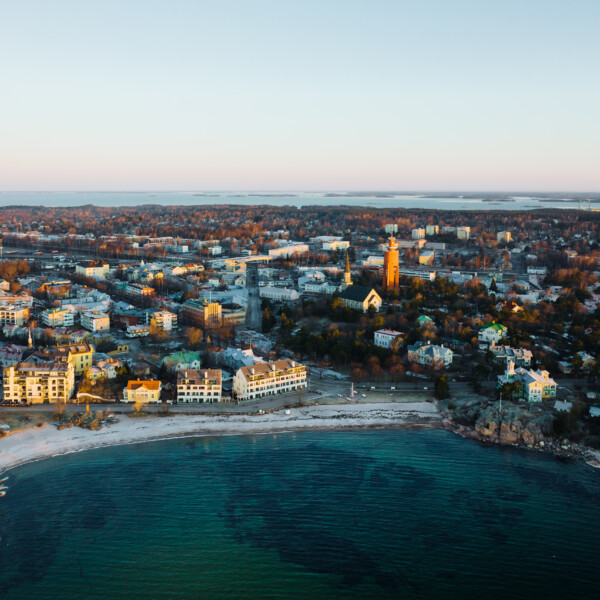
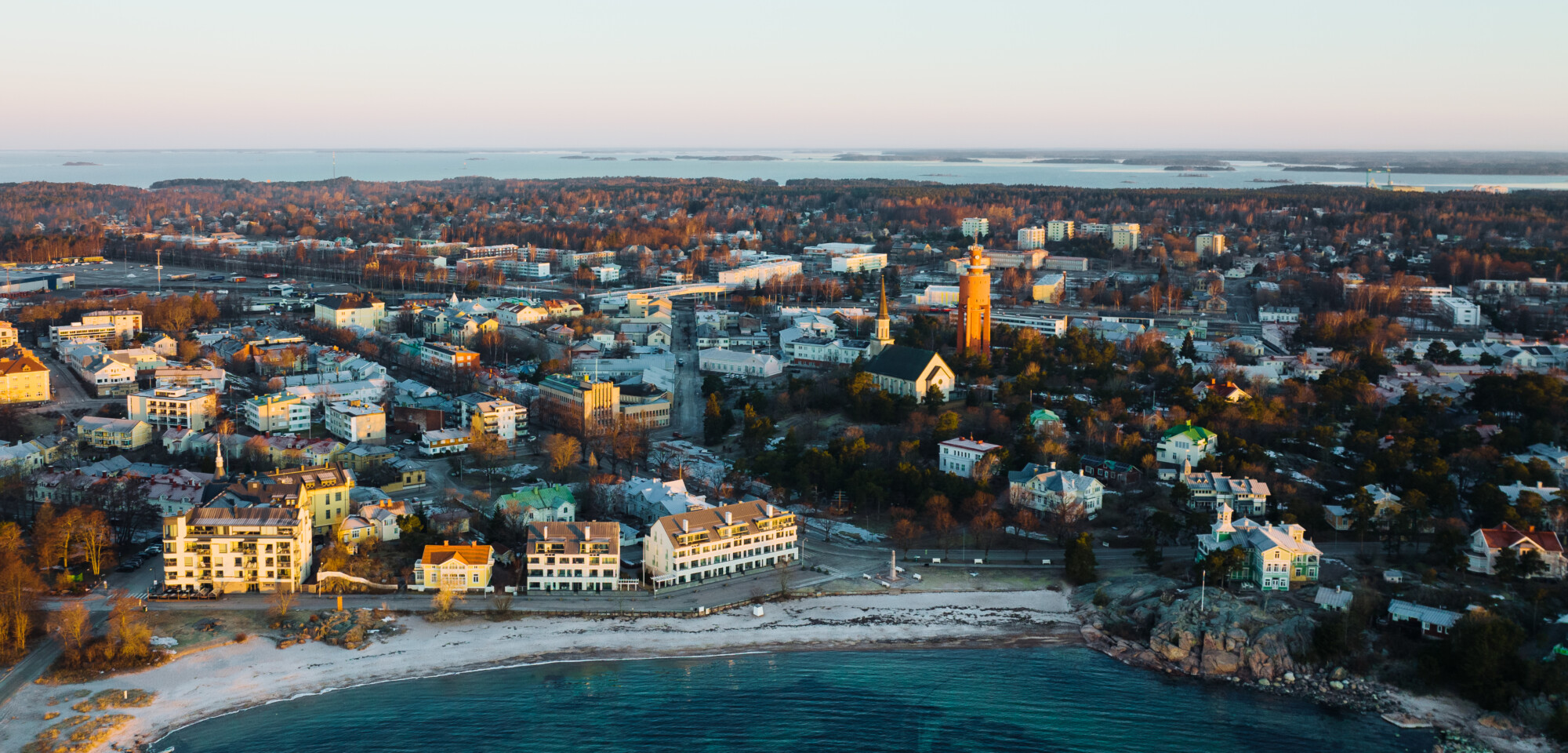
Hanko is committed to continuing its work to promote sustainable development. Here are a few examples of how ecological, socio-cultural, and economic sustainability are taken into account in sustainable development.
Ecological sustainability
Hanko has signed a contract regarding carbon neutral municipalities www.hiilineutraalisuomi.fi. This means that the town is committed to achieve reducing carbon neural emission by 80 percent by 2030.
Hanko – ‘capital’ of solar energy! The town has built 12 solar power stations on the roofs of the council buildings. The electricity is used in the buildings in question. This is sound economically and makes sense environmentally.
Recycling is cool! Please read more about recycling and waste sorting.
There are about ten smart waste bins in the center of Hanko. The bins are equipped with a compression system that allows them to hold over 1200 liters of waste. They use solar energy as their power source, which is stored in the bins’ batteries through efficient solar panels. The smart waste bins have a built-in measurement system that enables full utilization of their capacity without unnecessary intermediate emptying. The waste bins are cost-effective both economically and environmentally, taking into account their carbon footprint. The smart waste bins have been donated to the City of Hanko by the Hanko Rotary Club.
Hanko council owns electric cars that the employees may use. Residents and tourists are allowed to use them according to availability. There’s an app for it, so using is convenient. Read more about the electric cars. Please note that the website is in Finnish by default and there is a Translation-button you can use to get the information in English.
In Hanko distances between places are short and it’s easy to use a bicycle for getting from A to B. The town is ideal for cycling. There are local companies that you can identify them from their Welcome Cyclist -badge. Further information Bikeland.fi. Read more about cycling in Hanko.
An area of the town is part of a national urban park. Read about national urban parks on
Ministry of the Environment and National urban parks in Finland. The goal of a national urban park is to treasure and cherish the unique cultural and national environment. In the national urban park there are for example five conservation area that are mostly included in Natura 2000 network. This is a significant amount of conservation areas in proportion to its size.
The harbour in Hangonkylä, Itämeren portti and Eastern harbour (Itäsatama in Finnish) are so called Roope harbours. Roope-service is an environmental program by Keep the archipelago tidy Association.
Finland’s tap water is among the highest quality in the world and is not only completely safe but a pleasure to drink. In Finland, tap water has actually been found to be significantly cleaner than bottled water.
Visit Hanko is part of the Carbon Neutral Experience 3.0 (CNE 3.0) project, whose main goal is to achieve carbon neutrality in the tourism sector in the Uusimaa region by 2030. A total of 12 municipalities in the Uusimaa region have committed to the project. The project supports tourism businesses, among other things, in calculating their carbon footprint. CNE 3.0 also offers company-specific neuromarketing research.
Visit Hanko also participates in the Digi+Hiiletön 2.0 project. The goal of the project is to support small and medium-sized tourism companies in the Uusimaa region in transitioning to a circular economy, to promote companies’ digital green transformation, and to foster co-development within business networks.
The City of Hanko participates in the Länsi-Uudenmaan Luontohelmet project, which aims to preserve and manage dunes, traditional landscapes, and their characteristic biological communities. The project’s actions strengthen local biodiversity. The work is guided by the Uusimaa Centre for Economic Development, Transport and Environment (ELY Centre), and the main funder is the Helmi Habitat Program under the Ministry of the Environment. In Hanko, the project includes 15 field sites, including coastal areas, meadows, dry grasslands, and dune forests. Furthermore, the threat posed by climate change emphasizes the importance of the project, as Hanko’s beaches are expected to shrink significantly due to rising sea levels, potentially causing the shoreline to retreat by up to ten meters. This shrinkage primarily affects the biodiversity of species living along the shores.
The city has separate environmental protection regulations that apply throughout the entire city area and bind all activities within the city, regardless of residence. The regulations clarify the interpretation of environmental legislation, including water protection, air protection, noise control, and waste management.
Socio-cultural sustainability
Hanko is committed to accessibility and sustainable tourism. The town has developed an accessibility strategy to ensure that pedestrian areas are safe, smooth, and enjoyable, while also making the urban environment more walkable and welcoming.
As a part of the Digi+Hiiletön 2.0 project, Visit Hanko is working with local partners in the field of tourism on a new tourism strategy with shared goals to make the region a better destination for everyone.
Visit Hanko also celebrates local entrepreneurs who make a positive impact on tourism. In 2025, a sustainability award was introduced to honor those who work responsibly and long-term for the benefit of the region.
To make Hanko more accessible online, the city has launched the VoiceIntuitive program, which translates the website into English, Ukrainian, Estonian, and Kurdish—adding to the existing Finnish and Swedish versions.
In summer 2025, a visitor survey gave valuable insights into Hangö’s appeal, sustainable tourism, and visitor spending. The results were promising: 69% of respondents consider sustainable tourism very important, around 89% would recommend Hanko, and over 80% plan to return.
Economic sustainability
Visit Hanko monitors tourism development on a monthly basis using Visitory’s tourism statistics. The data is based on accommodation statistics and the Finnish telecom operator Telia’s mobile phone data. These statistics are an important tool for data-driven management, trend monitoring, and decision-making. All visits in the area that last more than 20 minutes are a part of the statistics.
Tourism is an important part of Hanko’s economy, alongside port operations and industry. Visit Hanko commissions an annual tourism revenue and employment report prepared by Visitory.
Hanko Tourist Office and a few other Hanko based companies are taking part in Sustainable Travel Finland program. The target is to receive the STF-label in order for travellers to identify sustainable travel companies. The Tourist Office, Regatta SPA Hotel, Silversand Resort & Camping and Seastar Events have been awarded the STF-label.
Visit Hanko has been awarded the prestigious Sustainable Travel Finland label as resort in recognition of its long-term work to develop responsible tourism.